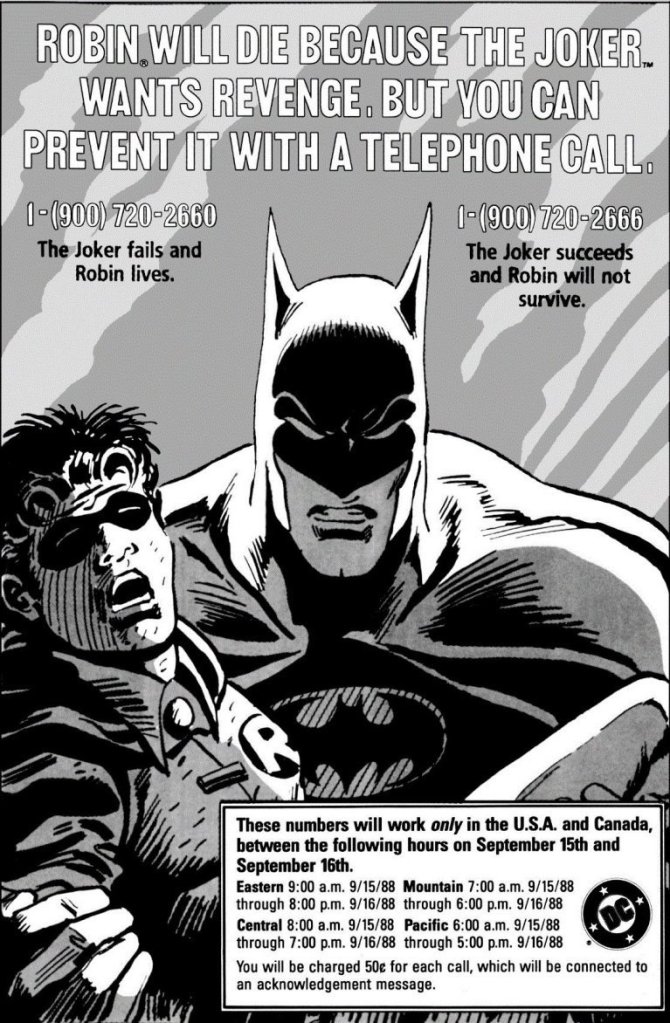
35 years ago this month, the first issue of A Death in the Family, Batman #426, was released. The following month, DC Comics would change social engagement with comic brands forever by running a full-page ad in the back of Batman #427 with two telephone numbers-one to call to save Jason Todd, and the other to send him to his death.
Results were basically tied, with the outcome coming down to a paltry 72 votes. At the time, phone polls were basically unheard of- the only previous time they’d been used in a major pop culture historical circumstance was Eddie Murphy’s Larry the Lobster sketch for SNL in 1982. Of course, now phone polls have gone the opposite way out of style in favor of texting and Instagram polls, but back then it was completely novel and out-of-the box marketing.
Of the phone poll’s tight margins spun out an unsubstantiated rumor that even Dennis O’Neil acknowledged in an interview, of one man had programmed his computer to call the “Jason dies” number over and over again, which pushed the final nail into Jason’s coffin. In 2019, DC recreated the phone poll, though this time Jason managed to escape with his life. (although when I cast my votes, things were dangerously tied again and I was worried!)
However the voting went, the fact that this fan-inclusive marketing tactic occurred helped set the stage for the importance of viral social marketing today. In a world where I literally have most of the Big Two’s past publications on my cell phone at any time I want, thanks to digital streaming services, connecting with the audience is of utmost importance for any brand.
Social Engagement
All these years, I’ve considered myself to just be writing stories. I now know that that’s wrong. That Batman and Robin are part of our folklore. Even though only a tiny fraction of the population reads the comics, everybody knows about them the way everybody knows about Paul Bunyan, Abe Lincoln, etc. Batman and Robin are the postindustrial equivalent of folk figures. They are much deeper in our collective psyches than I had thought.
Dennis O’Neil, “Notes from the Batcave: An Interview with Dennis O’Neil.”
While the late Dennis O’Neil shared the above quote, it was part of the media obsession with the Burton Batman film released in 1989. In the time since the public’s obsession with superheroes has only grown. (Ironically in a major way thanks to A Death in the Family author Jim Starlin’s next major arc for DC rival Marvel- The Infinity Gauntlet, which became the basis for the first phase of the Marvel Cinematic Universe.) Comics have progressed from the niche alternative audience demographic of the mid-to-late eighties to ultra-mainstream pop culture staple.
Modern social media marketing has helped to popularize comics by providing ease of access to not only the stories but the creative teams who write and design them, as well as providing near-instant feedback to the publishing brands on major arcs and developments. On DC’s twitter feed, the very first non-pinned post as of writing this article is literally a twitter poll on which major fictional DC city fans would want to live in. Yesterday, their instagram featured a series of posts promoting titles through non-traditional synopses- playing off of the Google search engine’s “Did You Mean…?” feature.
While DC’s twitter may have less than half as many followers as their Instagram, they’re still reaching over 17 million people with their combined follower counts for the brand’s main account feeds, not taking into account followers for their sub-brand accounts like Batman, Superman, and Wonder Woman, or their merchandise specific influencer styled account on Instagram, DC Lifestyle. Interestingly, Instagram’s target demographic skews most heavily female of the three major social media account hosting sites (Facebook, Instagram, Twitter) with 49.3% of users identifying as female in 2020. DC only offers the DC Lifestyle account on Instagram, while most of their other sub-brand accounts are uniform across the board.
Marvel, the other half of the big two, is even more active on social media fronts thanks to their accusation by brand giant Disney. Utilizing the decades of nostalgia commercialization and brand development from Disney has enabled Marvel to not only target their main audience reach for retention but also expand to new audiences with targeted advertising. In preparation for today’s launch of the streaming series She-Hulk on Disney+, Marvel even launched a Tinder account, even more heavily targeting the male millennial demographic. While I could write an entire post about how this marketing strategy dehumanizes women for the sake of laughs for this series, it also serves as an important reminder to diversify your advertising audience when you’re saturating your standard market.
Disclaimer: I am employed by the Walt Disney Corporation, but any opinions shared on this site are my own, and in no way reflect that of the company.
Both of the big two’s marketing strategies have shown that outside-the-box thinking and unexpected ways of engaging a customer base encourages both growth and reduces churn. Much like audiences who knew that DC would never kill off an iconic teen sidekick so they cast their votes to kill off Jason Todd, or staggering Marvel cinematic storytelling across platforms and phases, audiences consistently see that they have no idea what’s going to happen next. And that keeps them coming back, just like Jason Todd.
PS. You can follow Pages and Panels on Instagram, Twitter, and Facebook!
 Pages and Panels
Leave a comment