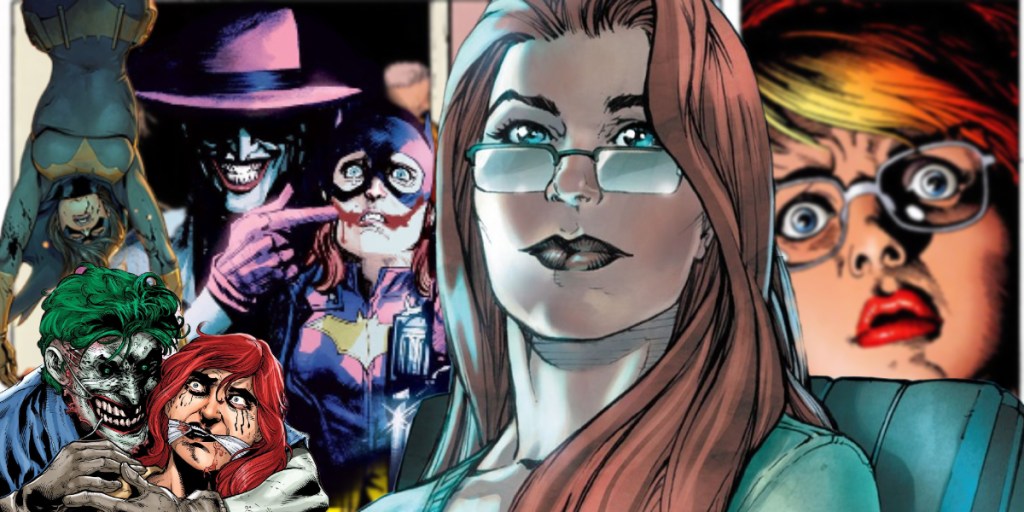
Barbara Gordon, the original female compatriot to Batman, is one of the characters who has undergone the most transformation and regression in the comics industry. As Gordon is “not motivated by revenge or tragedy. She fights crime, and she wants to take up the bat mantle because of a moral sense of wanting to do good” (Coogan 619), she has a more innocent quality and representation in opposition to the harsher characters seen in the 1980s Batman panels. This meant that the actions of Alan Moore’s Batman: The Killing Joke violated her character in ways much deeper than perhaps intended, and the actions of that story arc have shaped her character into one who may not ever be able to fully empower herself without recognition of those events.
The Killing Joke
When Alan Moore first proposed the disfigurement of Barbara Gordon in his 1988 story Batman: The Killing Joke DC editors reportedly responded to his idea to paralyze her by responding “Yeah, Okay, Cripple the Bitch.”
Not only does this issue rob her of the physical ability to walk and sexualizes her in her injury, but she also does not even feature as the main character. Arguably, it’s one of the defining moments of her characterization, and Barbara Gordon still takes a backseat to Batman, even in the title.
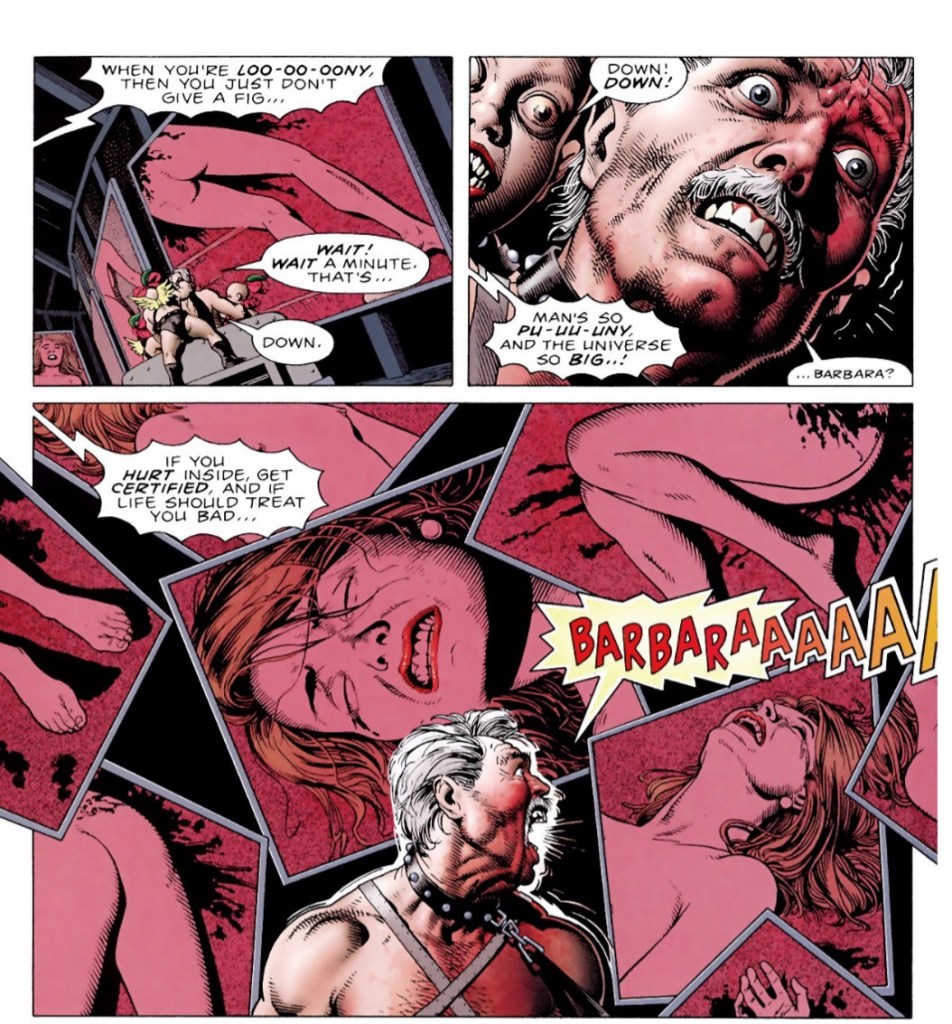
In the panel where Gordon’s father, Commissioner Gordon, has been taken captive by the Joker is shown. Commissioner Gordon, and by proxy, the audience, are tormented by the visuals of a naked and sexualized Babs. Rather than choosing to simply insinuate her nudity, like in the photograph in the lower right-hand corner of the panels, there are two definitive and one suggested image of her nude buttocks. This panel comes shortly after Batman goes to see Babs in the hospital, where it is confirmed that the spinal injury has paralyzed her from the waist down. This injury, which should be the most defining aspect of the attack, is not even represented visually in the tormenting of the Commissioner. Instead, the nudity of her physical body is the visual focus of their suffering
Film Adaptation of The Killing Joke
In 2016, Warner Brothers and DC Comics released an animated adaption of Batman: The Killing Joke. Nearly thirty years after the source material, the brand was given the opportunity to make Barbara Gordon more active in the plot of the story, as well as present the opportunity for feminine empowerment in the disability community. Gordon had returned to the role of Batgirl just a few years prior, after spending most of her time as a hacker and strategist for the various heroes in the canon.
Instead, the additional thirty minutes of background to her character development introduced the idea that she and Batman had sexual relations shortly before the events of the Killing Joke. Not only that, but the implication of the visuals presented in the comic (which were censored by undergarments) is combined with “a line that suggested the Joker rapes Barbara Gordon” (Dockterman 2016). Rather than providing the development that would at least help justify treatment that “strips [Gordon] of her power in a manner that would never happen to a male character” (Dockterman 2016), the filmmakers decided to continue their “fridging” of the character by providing more emotional damage and unnecessary sexualization of the character through an underdeveloped sexual relationship with an older male father figure.
A/N: The following is additional information and analysis that I feel helps express my ideas and opinions about the 2016 film adaptation, but due to the limitations of word counts, were not included in my original essay.
The explicit nature of Babs’s relationships is the focus of each of her cinematic relationships during the Killing Joke. Her fights as Batgirl in the film are filled with sexualized innuendo and framing, especially since the villain she’s facing is committing acts of abuse and assault against sex workers. Then she makes the choice to walk away from Batgirl, which takes the little agency afforded to the character away. After thirty minutes of what is assumed to be character development (although I personally question that), Babs is reduced to a physical prop for the men in her life by tainting the pseudo-paternal relationship between Barbara and Bruce for an explicitly described scene that turns Babs from frustrated protégé to spurned ex-lover before maiming her for the shock value.
The Three Jokers
When Gordon returned to the role of Batgirl in the mid 2000s, it was the result of a medical miracle. From then on, readers see her in the various books on her feet again. Once again, this story arc was headed by Gail Simone. Simone managed to bring Gordon “back as a vulnerable, emotionally and psychologically scarred woman, deeply anxious about being exposed to the criminals she used to fight, but whose bravery and courage helped her work through her trauma” (Curtis and Cardo 2018, 387). However, once again, after Simone moved onto a new project, the focus shifted from empowering the character to using the character’s tragedy to push the responsibility of growth and support of the male characters onto her.
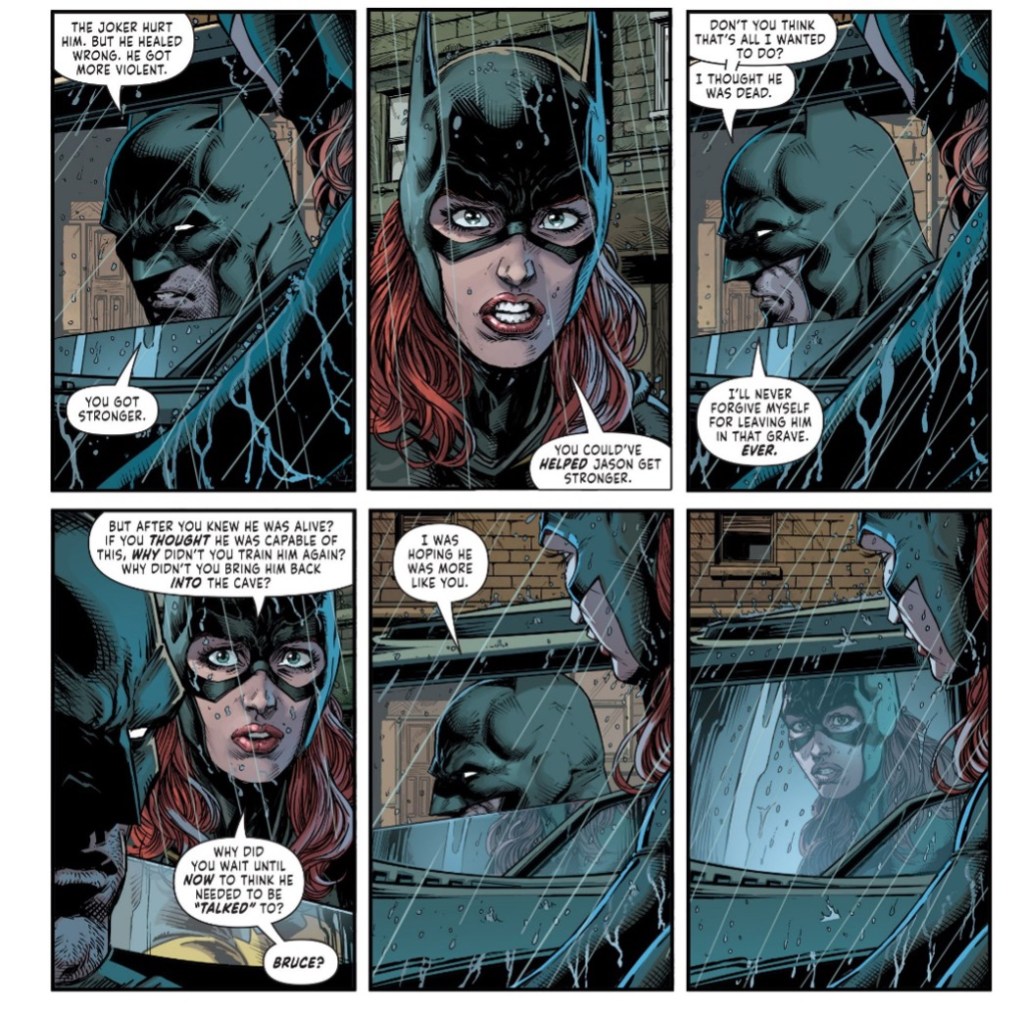
Demonstrated in the above panels from The Three Jokers, Batman shifts the responsibility of Jason Todd, former Robin turned anti-hero, onto Gordon. Both Gordon and Todd were brutalized by the Joker, but Jason has focused his energy on violence and revenge as the crime lord, Red Hood. Even as Gordon criticizes Batman for allowing the emotional damage of Jason Todd, her facials are softer and focused on wide, shining eyes, a harsh contrast from Batman, whose eyes posses no defining features, not even a pupil, a trait shared by Todd, who is also the adopted son of Batman. This emphasizes Barbara Gordon as the character with humanity left, which also leaves her emotionally distraught as Batman shifts the responsibility of working through his son and former partner’s trauma to Barbara Gordon.
The Cold Shoulder
There’s been a lot of criticism of the current run of Nightwing, particularly surrounding Tom Taylor’s writing for Barbara Gordon. Taylor has been accused of being ableist for his presentation of Babs by embracing the Burnside arc version of the character. There’s a lot to unpack with that issues and these accusations that I’m not actually well-versed enough in to feel comfortable breaking all that down. However, this is an excellent article on Tumblr from a user named Maeve that explains these issues from a perspective I am unable to provide. Personally, I’m a big fan of Tom and the creative team behind this run of Nightwing, but even I can respect, appreciate, and listen to the critiques of Taylor’s run by those who feel the most represented by this character.

That being said, I cringed so incredibly hard at the tone-deaf nature of this panel from Nightwing #90. Having a character so deeply rooted in the Women in Refrigerators movement saying this particular sentence absolutely fell flat for me. Instead of it being fun and quirky, it just highlighted male comic creators’ callousness and dismissal of the the trope, issues, and treatment of women in the industry.
Taylor is good friends with Gail Simone, who founded the WiR website, and I assume this line was one of his many shout-outs to her. But Simone is so deeply woven into the ethos of Barbara Gordon’s characterization as Oracle and Batgirl that the HBO Max Titans series named their adaptation of the character “Barbara Gail Gordon”. Simone’s been vocal in her passion for the character. The later versions of the character that she wrote focused on delving into how Gordon’s tragedy shaped her into a stronger and more independent woman, capable of doing more as Oracle than she could as Batgirl.
Fans were outspoken in their love for the new version of the character. Many felt as though the later iterations of Gordon after Simone left the character were a massive setback. Rather than focusing on Babs’s intelligence, skill, wittiness, and character development, the character’s stories regressed to focus on her near-magical “cure” for her spinal injury and her fear of having to use a wheelchair again.
Obviously, the choice to heal Barbara’s spine came from the Editors at DC and aren’t directly from Taylor. But his choice to highlight the trope that has plagued Barbara Gordon since the editor said “Cripple the Bitch” as an in-text inside joke was just tasteless and crude. While It wasn’t intended to do so, the reality is that it’s once again a male creator poking fun at the treatment of women in this industry, not just at the characters. This throwaway line about getting fridged doesn’t bring attention to the use of the trope or the history behind it. Instead, it makes light of a seriously messed up symptom of misogyny in this industry by poking fun at one of the most vocal women who called out this trend.
Up Next Time: Slavery, Sexualization, and Starfire
For many people my age, one of our formative exposures to DC Comics characters came from obsessive viewings of Teen Titans on Cartoon Network. However, the sweet and sassy Tamaranean princess was more scandalous in print and her later adaptations have caused quite a bit of controversy on and off screen.
 Pages and Panels
Leave a comment